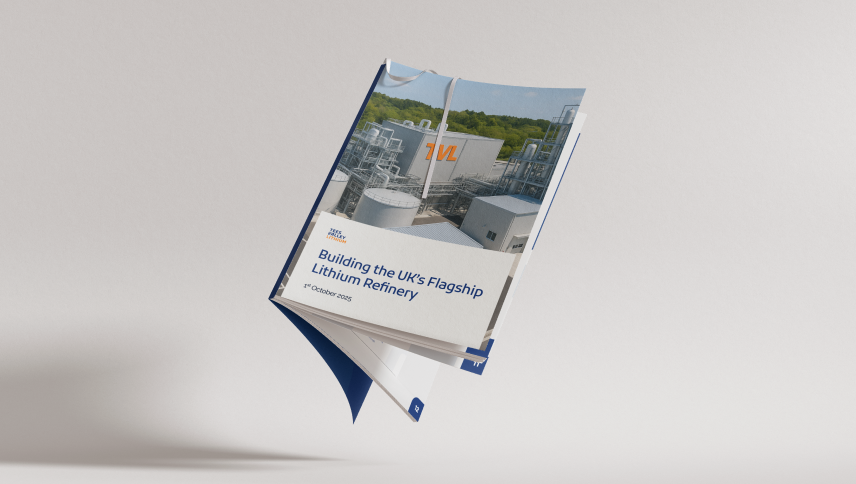
Centre will give customers early access to representative product, shortening the time from first production to full commercial volumes at Train 1
“Customers told us plainly what they need: our product in their hands, early,” said Vikki Jeckell, Chief Executive of Tees Valley Lithium.
Tees Valley Lithium (TVL) is to establish a Qualification and Validation Centre at the Billingham Chemical Complex, Teesside. The move responds to requirements from existing and prospective customers, including cathode manufacturers, cell manufacturers and OEMs.
Battery and cathode manufacturers validate a new supplier’s lithium hydroxide in their own production lines, a process that typically takes twelve months. For a new refinery, this usually begins once the plant is producing.
The centre will give customers early access to representative battery-grade lithium hydroxide, so validation can run in parallel with the construction of Train 1, the first 25,000 tonne per year production train of TVL’s refinery at Billingham. This is expected to shorten the time from first production to full commercial volumes.
The centre will be housed in an existing industrial building within the Billingham Chemical Complex. Its sampling line will replicate the Train 1 process configuration using Veolia’s process technology, so the product customers test is representative of the product the refinery will make. A customer and visitor area will allow customers and partners to review material and process performance at first hand.
The centre will also allow TVL to validate a wider range of feedstock, including lithium recovered by TVL’s battery recycling partners. Recycled feedstock supports customers’ obligations under the EU Battery Regulation, which requires minimum recycled lithium content in new batteries from 2031, with batch-level traceability provided through TVL’s partnership with Circulor.
Once complete, the centre will be able to process samples of lithium carbonate from Geothermal Engineering Limited’s demonstration plant in Cornwall, refining them to battery grade.
Vikki Jeckell added: “Qualification now runs alongside the development of the refinery rather than after it, which brings forward the point at which customers can move to commercial volumes. It also lets us test mined, brine and recycled feedstock side by side, and show that UK lithium, including domestic Cornish lithium from GEL, can be refined to battery grade on Teesside.”
Paul Atherley, Chairman of Alkemy Capital Investments, said: “The UK needs its own lithium-refining industry, and that industry will be built on the confidence of the customers it supplies. The Qualification and Validation Centre brings those customers to Billingham to work with TVL’s product firsthand. It is another practical step in building the world-class merchant lithium refinery the United Kingdom needs.”

The UK Government has released its refreshed Critical Minerals Strategy – Vision 2035, setting out a renewed national plan to secure the minerals essential for clean energy, advanced manufacturing and industrial resilience. The strategy establishes clear demand projections, domestic production targets and a firm commitment to strengthening supply chain security through a combination of domestic capability and international partnerships.
Critically, lithium is placed at the heart of the UK’s long-term industrial future, with the Government highlighting that lithium demand is expected to rise by 1,100 percent by 2035. The strategy sets a dedicated ambition for lithium: producing 50,000 tonnes of lithium (LCE) domestically by 2035, representing roughly 15 percent of national demand. This heightened focus reflects lithium’s central role in electric vehicles, battery energy storage, and the wider clean energy transition.
Teesside is also recognised as one of the UK’s regional strengths for critical mineral processing, a significant validation of Tees Valley Lithium’s decision to anchor the UK’s flagship lithium hydroxide refinery on Teesside. The strategy places strong emphasis on the UK’s competitive advantage in midstream processing, precisely the part of the value chain TVL is delivering.
New policy measures, including the proposed extension of energy support schemes, are welcome steps that create a more attractive environment for the large-scale investment the UK will require. While additional support will be necessary to meet the UK’s ambitious 2035 targets, the direction of travel is clear: domestic refining capacity is now recognised as a strategic national priority.
For TVL, this strategy provides powerful confirmation that our approach has been the right one from the outset. Established well before the publication of Vision 2035, TVL has been progressing at speed — and the Government’s updated framework now firmly aligns with our mission to build a flexible, future-ready and globally competitive lithium refinery on Teesside.
Download our full review of the new Strategy here.
UK Critical Minerals Strategy in Full
Tees Valley Lithium (TVL) has launched its Supplier Expression of Interest (EOI) process as the company continues to progress its Front-End Engineering Design (FEED) study for the UK’s first large-scale lithium hydroxide refinery.
The new Supplier EOI Portal provides an opportunity for businesses of all sizes to register their interest in supporting the project’s delivery, construction, and future operations. Companies are invited to select all relevant project categories and services they can offer – from civil engineering and fabrication to logistics, maintenance, and specialist chemical services.
Once registrations are received, the TVL team will review submissions and issue Pre-Qualification Questionnaires (PQQs) to suitable suppliers. This process will help build a strong and diverse local supply chain to support the refinery as it moves towards its Final Investment Decision (FID) in early 2026.
Pauline Sumner, Project Procurement of Tees Valley Lithium, said:
“This is an exciting time for Tees Valley Lithium and the broader Teesside region. We’re calling on suppliers, both established industry players and local SMEs, to register their interest and become part of this landmark project for the UK battery materials industry.”
To learn more about upcoming opportunities, please click the link below to access the registration form.

ABG Sundal Collier engaged to lead Train 1 financing
TVL is delighted to announce the appointment of leading European financial institution ABG Sundal Collier to arrange the funding for the construction of Train 1 of the UK’s flagship lithium refinery in Teesside. This is another step forward as we progress towards producing battery grade lithium hydroxide by 2028.
It is anticipated that the proposed US$245 million funding will be secured at the TVL level after having reached a final investment decision in early 2026 and will be composed of a blend of bonds, government grants and institutional equity.
ABGSC has an outstanding track record in the natural resources sector, raising over US$11 billion in bond markets since 2018, further strengthening TVL's pathway towards becoming a key player in the UK and Europe's green energy transition.
Chairman Paul Atherley commented:
"This partnership with ABGSC marks a significant milestone for Tees Valley Lithium, as we move towards delivering Europe's largest independent lithium hydroxide refinery. Securing this funding will allow us to complete Train 1 of this strategically important project, delivering 25,000 tonnes per annum of lithium hydroxide. The future looks extremely bright for TVL as we work to meet the growing demand for battery-grade lithium in Europe."
At Alkemy Capital, we’re entering a pivotal chapter in the journey of Tees Valley Lithium (TVL). As we move deeper into the FEED phase and lay the groundwork for construction, our Chairman, Paul Atherley, has shared a personal message about why he’s chosen to stand behind this next stage.
Here’s what he has to say:
"Over the past few months, we’ve made meaningful progress behind the scenes, and today I want to personally share why I’ve chosen to back the next phase of development for Tees Valley Lithium.
We’re now deep into the FEED study, with engineering and cost work progressing well. We’ve secured our feedstock, have advanced discussions with Tier 1 off takers, and continue to work closely with ABG Sundal Collier on the debt financing package.
Alongside that, we’ve been working with Ara Partners, a credible, specialist investor focused on industrial decarbonisation, who have undertaken months of technical, commercial, and strategic due diligence. That process has now led to an indicative term sheet outlining their interest in leading the full $100 million equity investment at the construction stage.
This progress has given me the confidence to personally back the FEED phase. Through a secured £5 million facility, Alkemy can fund the fullFEED study while retaining 100% ownership of TVL, ensuring we protect early-stage value for shareholders and only introduce external equity when it matters most.
The proposed structure with Ara, currently in final negotiation, includes a right of first refusal framework and a clear milestone path aligned with our Final Investment Decision (FID) in Q1 2026. It gives Ara the option to deploy capital at construction and gives Alkemy the ability to advance TVL with strong institutional alignment.
We’d like to thank Ara Partners for their detailed engagement to date and the time and expertise they and their advisors have committed to the process. We look forward to continuing to work closely together as we progress toward construction."
Join Us: Shareholder & Investor Webinar
We’ll be hosting a live investor webinar where I’ll be joined by TVL CEO, Vikki Jeckell, to share more detail on the FEED progress, funding structure, and next steps toward FID and construction.
Date: Tuesday 5th August 2025
Time: 12:00pm BST
Register here: https://us02web.zoom.us/webinar/register/WN_L4ss1hPrQtKS_53rPp5gxA
We’re proud of the momentum building around TVL and excited about what’s ahead. Stay up to date with the latest project milestones, investor news, and company updates from Alkemy and Tees Valley Lithium - subscribe to our newsletter today.

The Lithium Deficit Is Coming – TVL Is Ready to Meet the Demand
A long-term feedstock agreement that fuels the UK’s flagship lithium refinery
Tees Valley Lithium (TVL) is pleased to announce the signing of a binding feedstock agreement with Touchstone Capital Partners’ Chilean lithium project – Project Llamara, securing up to 100,000 tonnes of lithium carbonate equivalent (LCE) over a five-year period.
This agreement marks a significant step forward in TVL’s mission to deliver the UK’s flagship lithium hydroxide refinery and build a secure, low-carbon supply chain to support Europe’s transition to electrification.
Located in the Salar de Llamara in northern Chile, Project Llamara is one of the world’s most lithium-rich brine resources. Its high-grade, low-impurity brines support efficient extraction with a significantly reduced carbon footprint compared to hard rock mining, perfectly aligned with TVL’s sustainability-driven strategy.
With this long-term feedstock supply secured, TVL is now ideally positioned to advance its Front-End Engineering Design (FEED) phase and maintain momentum toward first production. Project Llamara is targeting initial output in 2026, matching TVL’s ramp-up schedule and preparing us to meet rising demand just as the global lithium market tightens.
TVL CEO Vikki Jeckell commented:
“Securing high-quality, low-carbon lithium from Project Llamara is a major milestone for Tees Valley Lithium. It gives us the confidence and credibility to push forward as the UK’s flagship lithium refinery and deliver the secure, sustainable supply our future battery customers are counting on.”
Watch the video above to hear more about what this agreement means for the future of lithium refining in the UK.

The Fastmarkets Lithium Supply & Battery Raw Materials Conference 2025 in Las Vegas brought together over 1,000 delegates and more than 500 companies, confirming its status as one of the most influential events on the global battery materials calendar.
From mining firms and government agencies to engineering specialists, battery recyclers and end-use customers, the entire lithium value chain was represented - and the message was clear: the world is waking up to the urgent need for resilient, sustainable, and regionally anchored supply chains.
Strong Interest in the TVL Opportunity
Tees Valley Lithium had a full schedule throughout the week, with back-to-back meetings reflecting growing interest from potential partners, customers, and investors. Our FEED study, feedstock strategy, and future production capacity were key talking points, with many recognising the critical role TVL is set to play in reshaping the European battery supply chain.
The conference also provided a valuable platform to strengthen existing partnerships and build new relationships with strategic players from across the ecosystem. The atmosphere was collaborative, forward-looking, and deeply aligned with the vision we are delivering in Teesside.
A Shift Towards Regional Security and Midstream Capacity
One of the most prominent themes across the event was the need for greater midstream processing capacity outside of China. As geopolitical pressures mount and demand accelerates, global markets are searching for credible alternatives, and the UK is firmly on the radar.
There was a clear focus on:
These priorities sit at the heart of our project. TVL is not only aligned with where the market is heading but we are helping to define the next phase of its evolution.
Looking Ahead with Confidence
Returning from Las Vegas, we are more encouraged than ever by the momentum behind the lithium sector and the clarity of the opportunity ahead. Tees Valley Lithium is in the right place, at the right time, with the right strategy.
As we continue to progress towards first production, we remain focused on execution, engagement, and delivering long-term value for our stakeholders.

BMW is steering the MINI brand into a new era of electrification, and it’s doing it from the heart of the UK. The company has announced a landmark £600 million investment to convert its MINI Plant Oxford into an all-electric production hub by 2030. This transformation underscores BMW’s commitment to sustainable mobility and reaffirms the UK’s vital role in the global electric vehicle (EV) transition.
Located in Oxford since 1913 and producing MINIs since 2001, the plant has long been a symbol of British automotive craftsmanship. Now, it’s becoming a symbol of innovation and electrification.
Starting in 2026, the plant will begin production of two new electric MINI models:
Both models are designed to blend the iconic MINI design with cutting-edge EV technology, meeting the rising demand for clean, compact, and stylish electric cars across the UK and Europe.
BMW’s £600 million investment will support:
With these changes, Plant Oxford will become one of the key global centres for MINI’s electric future.
BMW’s investment is more than just an upgrade. It’s a strategic move to:
As demand for electric vehicles continues to rise, having domestic production capacity ensures that MINI can meet consumer expectations while reducing carbon emissions across its value chain.
By 2030, every MINI produced at the Oxford plant will be electric, marking a full transition to zero-emissions production. BMW’s bold investment in electrification not only preserves a historic UK manufacturing site but positions it at the centre of the automotive future.

Nissan is placing the UK at the centre of the global EV revolution with its groundbreaking EV36Zero project where a £1 billion initiative will turn Sunderland into a flagship hub for electric vehicle innovation, battery production, and renewable energy integration.
Launched in 2021, EV36Zero is more than just a manufacturing upgrade. It's a complete ecosystem for electrification, combining advanced vehicle assembly, a battery gigafactory, and sustainable energy infrastructure, all on one site.
EVs at Scale: The Next Generation of Nissan Vehicles
At the heart of EV36Zero is the production of next-generation electric models, including:
These vehicles will be manufactured at scale, reinforcing Sunderland’s role as a major export base and a vital component of Nissan’s global EV strategy.
Nissan's Sunderland site has long been one of the UK’s largest car manufacturing facilities. With the EV36Zero upgrade, it now includes:
Together, these elements create a fully integrated, low-carbon manufacturing ecosystem - the first of its kind in the UK.
EV36Zero is designed as a replicable model for other global facilities. It shows how automakers, energy companies, and governments can collaborate to deliver sustainable transport at scale.
Nissan’s investment supports:
With strong support from the UK Government and private industry, Sunderland is fast becoming a template for the green automotive economy.
As the world accelerates towards zero-emission transport, the success of EV36Zero proves that the future of electric mobility can be built at home, with British engineering, global partnerships, and a commitment to sustainability.
From the North East of England, Nissan is setting the pace for the global EV race and Sunderland is leading the charge.


Tees Valley Lithium Ltd. is a registered company in the United Kingdom. The company is committed to operating in accordance with applicable environmental, regulatory, and industry standards. All partnerships and activities are conducted with a focus on transparency, sustainability, and ethical business practices.

.svg)
.png)