Centre will give customers early access to representative product, shortening the time from first production to full commercial volumes at Train 1
“Customers told us plainly what they need: our product in their hands, early,” said Vikki Jeckell, Chief Executive of Tees Valley Lithium.
Tees Valley Lithium (TVL) is to establish a Qualification and Validation Centre at the Billingham Chemical Complex, Teesside. The move responds to requirements from existing and prospective customers, including cathode manufacturers, cell manufacturers and OEMs.
Battery and cathode manufacturers validate a new supplier’s lithium hydroxide in their own production lines, a process that typically takes twelve months. For a new refinery, this usually begins once the plant is producing.
The centre will give customers early access to representative battery-grade lithium hydroxide, so validation can run in parallel with the construction of Train 1, the first 25,000 tonne per year production train of TVL’s refinery at Billingham. This is expected to shorten the time from first production to full commercial volumes.
The centre will be housed in an existing industrial building within the Billingham Chemical Complex. Its sampling line will replicate the Train 1 process configuration using Veolia’s process technology, so the product customers test is representative of the product the refinery will make. A customer and visitor area will allow customers and partners to review material and process performance at first hand.
The centre will also allow TVL to validate a wider range of feedstock, including lithium recovered by TVL’s battery recycling partners. Recycled feedstock supports customers’ obligations under the EU Battery Regulation, which requires minimum recycled lithium content in new batteries from 2031, with batch-level traceability provided through TVL’s partnership with Circulor.
Once complete, the centre will be able to process samples of lithium carbonate from Geothermal Engineering Limited’s demonstration plant in Cornwall, refining them to battery grade.
Vikki Jeckell added: “Qualification now runs alongside the development of the refinery rather than after it, which brings forward the point at which customers can move to commercial volumes. It also lets us test mined, brine and recycled feedstock side by side, and show that UK lithium, including domestic Cornish lithium from GEL, can be refined to battery grade on Teesside.”
Paul Atherley, Chairman of Alkemy Capital Investments, said: “The UK needs its own lithium-refining industry, and that industry will be built on the confidence of the customers it supplies. The Qualification and Validation Centre brings those customers to Billingham to work with TVL’s product firsthand. It is another practical step in building the world-class merchant lithium refinery the United Kingdom needs.”
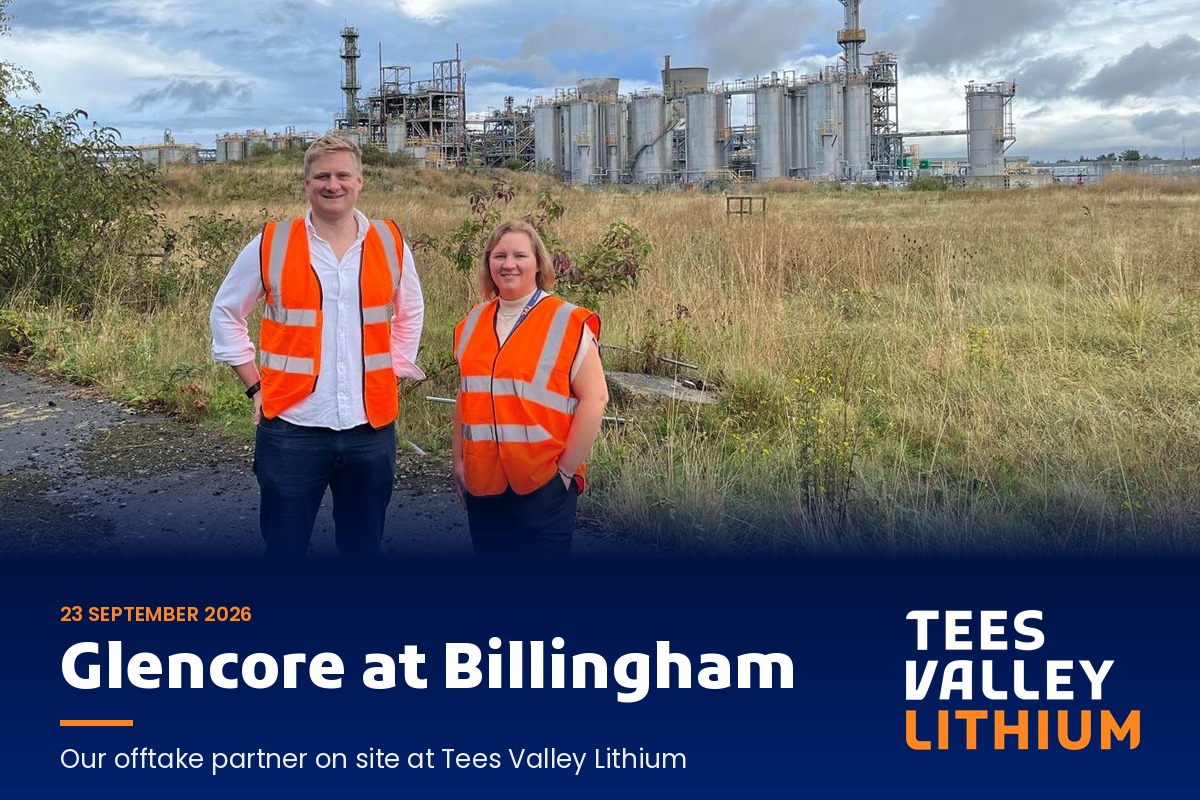
Our offtake partner came to Teesside to see where the UK's first large-scale independent lithium hydroxide refinery will be developed.
Glencore, one of the world's largest commodity traders, visited Tees Valley Lithium's site at Billingham on 23 September 2026.
Glencore signed a binding offtake agreement with TVL in January 2026, committing to buy battery-grade lithium hydroxide from our planned refinery. The visit gave Glencore the chance to see first-hand where that product will be made.
Chief Commercial Officer Gemma Cooper and Chief Operating Officer Richard Rose hosted the visit. It began with a tour of the site, in the heart of the Billingham chemical cluster. TVL's technical and commercial team then took Glencore through product specification, quality assurance and the qualification pathway. These are the steps that prepare for supply under the offtake agreement.
Vikki Jeckell, CEO of Tees Valley Lithium, said:
"Glencore is one of the most respected names in global commodities, and they have committed to buying our product. Having them on site in Billingham, seeing first-hand where it will be made, shows the strength of that partnership. Europe is investing billions in gigafactories, yet almost all the battery-grade lithium those plants will run on is refined outside the continent. Refining is where supply security is decided, and we're developing that capability right here on Teesside with partners of Glencore's calibre alongside us."
The visit follows the UK Government's offer in principle of up to £18.3 million of capital grant support for TVL under the DRIVE35 programme, announced on 17 September 2026.
An offer in principle under the £4 billion DRIVE35 programme backs Phase 1 of our Billingham refinery.
Tees Valley Lithium has received an offer in principle from the UK Government for a capital grant of up to £18.3 million under the £4 billion DRIVE35 programme.
The support is delivered by the Department for Business, Innovation, Science and Trade in partnership with the Advanced Propulsion Centre UK. It is subject to final approvals. TVL is working with the department to complete the remaining due diligence and conditions needed to enter into a final grant agreement.
The offer supports Phase 1 of TVL's refinery at Billingham, a £185 million development that will produce 25,000 tonnes a year of battery-grade lithium hydroxide. That is enough for more than 550,000 electric vehicles a year. TVL plans to scale the site beyond 100,000 tonnes a year.
Phase 1 alone represents nearly half of the refining ambition the UK Critical Minerals Strategy has set for 2035.
The project has strong commercial foundations:
TVL's Impact Report estimates the refinery will contribute more than £2.1 billion to the UK economy over 25 years, including around £1 billion in the Tees Valley, and support more than 1,700 jobs.
Blair McDougall, Minister for Reindustrialisation, said:
"This is a really encouraging milestone for Tees Valley Lithium and proves what's possible with this kind of British innovation and expertise. It shows the vast potential for refining and using critical minerals here in Britain to back our zero emission vehicle manufacturing for the future. Teesside has a proud industrial heritage, and companies like Tees Valley Lithium are helping write its next chapter. Our £4 billion DRIVE35 programme is backing businesses like this to grow, invest and help build the supply chains we need for the future as part of our Industrial Strategy."
Chris McDonald, MP for Stockton North, said:
“This is a huge vote of confidence in Billingham, Teesside and Britain’s industrial future. I have supported the Tees Valley Lithium project since becoming MP and worked closely with the team as they have developed plans for what will be a major new lithium refining facility here in Billingham. As the government's industry minister last year, I developed and launched Britain's critical minerals strategy, that is securing investments like this in new materials processing and mining facilities.”
Vikki Jeckell, CEO of Tees Valley Lithium, said:
"This grant is a statement of confidence in Teesside, and it is a confidence we share with partners around the world, among them Glencore and Veolia, who have already committed to what we are building here. The Critical Minerals Strategy set Britain the task of creating domestic lithium refining capacity, and TVL exists to deliver it: Phase 1 alone represents nearly half of the 2035 target. Our focus now is delivering first battery-grade production in the UK.”
Paul Atherley, Chairman of Alkemy Capital Investments, said:
“We are very grateful to BIST and the Advanced Propulsion Centre for their support for the establishment of the UK’s flagship lithium refinery in Teesside. Located in the heart of Teesside’s port and industrial cluster and drawing on the region’s extensive chemical engineering heritage this future facing refinery will be one of the largest in Europe and will position the UK at the forefront of the biggest energy transition in history.”
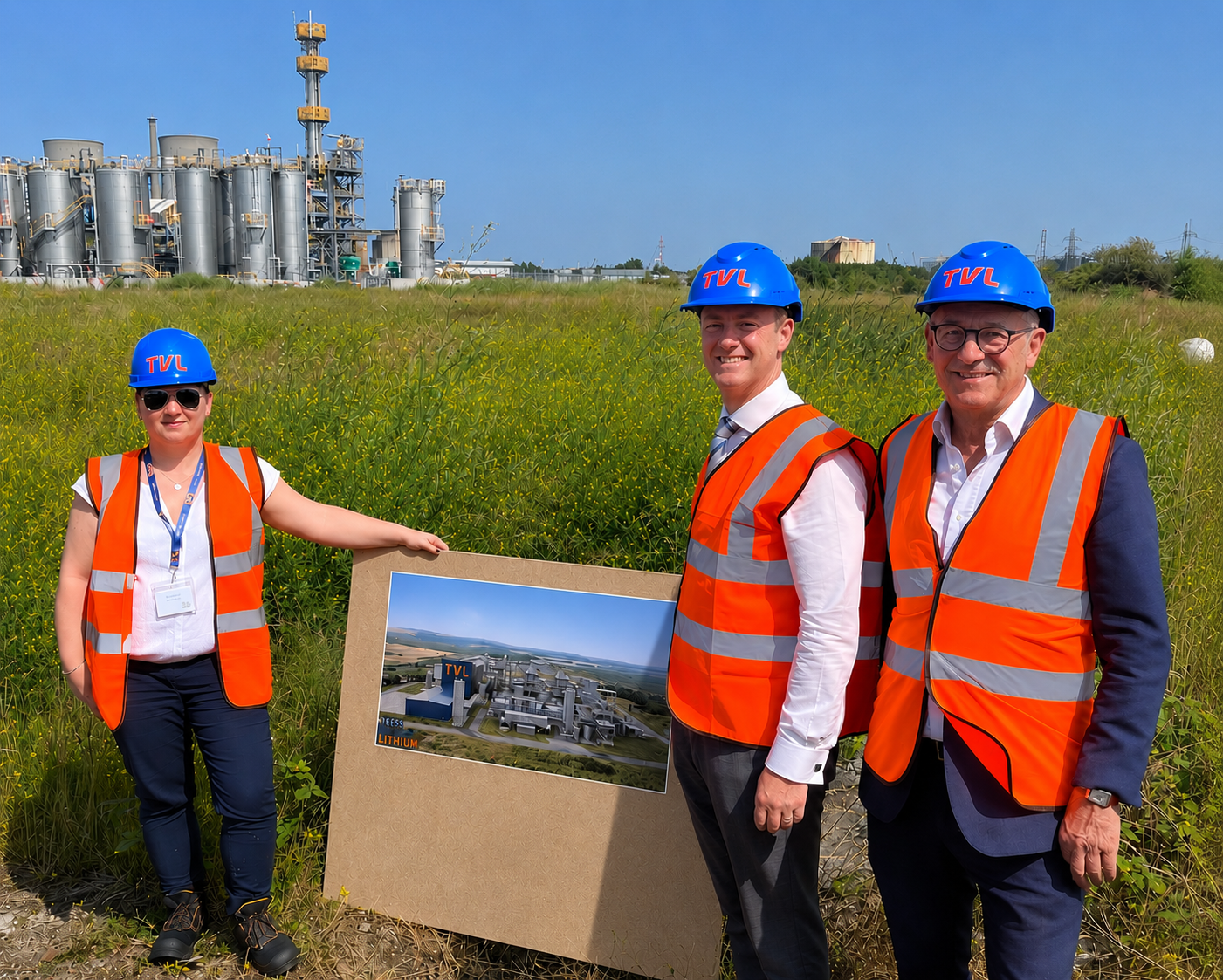
On Friday 10th July, we were delighted to welcome our local MP, Chris McDonald, to the future home of Tees Valley Lithium located in Billingham at the heart of the Teesside chemical cluster.
The visit gave the opportunity for the TVL team to explain in detail the plans for our refinery within the context of the established industrial cluster, as well as discussing the key policy priorities for the wider chemicals and process sector, such as ensuring competitive energy costs. As a politician with a background in Teesside industry, Mr McDonald showed a deep interest in the plans for the plant and the opportunities for local supply chain businesses to support the delivery of the project.
During the visit, Chris also heard from the team and Chairman, Paul Atherley, about the significant progress being made on commercial partnerships with customers and feedstock suppliers. Following the recently announced partnership with Canadian E3 Lithium, there was discussion of the range of domestic and international partnership opportunities the team are working on to secure a diversified lithium supply chain for UK and European customers. The £185 million merchant refinery will be one of Europe’s largest lithium refineries converting high value feedstock with full traceability, including feedstock from recycled sources, into battery grade lithium to support 550,000 electric vehicles annually.
Following a tour of the site and discussions with the team, Chris described Tees Valley Lithium as “a project of national importance…” in a region “…with the skills, infrastructure and logistics already in place” to support the building of a resilient critical minerals supply chain for the UK and Europe.
TVL CEO, Vikki Jeckell, commented “We are grateful that Chris made the time to visit and discuss our plans for the Billingham refinery in detail. There has been fantastic local support for the project and it was clear to our team that Chris is passionate about supporting the Teesside chemical and process sector to develop a new generation of opportunity for the area.”
TVL has signed non-binding Heads of Terms with Canadian lithium developer E3 lithium, establishing the framework for a long-term tolling partnership covering up to 50,000 tonnes of battery-grade lithium hydroxide over a minimum 10-year term.
The partnership is another step in building a diversified portfolio of commercial relationships across the global battery materials supply chain. TVL is building a world-class merchant lithium refinery in the Billingham chemical cluster on Teesside. Converting high-value feedstock from a diversified domestic and international supply base into battery-grade lithium using Veolia's commercially validated process technology. At full Train 1 capacity, that is enough lithium to support the production of 550,000 electric vehicles a year.
Under the arrangement, TVL will convert lithium carbonate form E3's Clearwater Project in Alberta into battery-grade lithium hydroxide at Teesside. It follows the binding offtake agreement signed with Glencore plc in January.
A Strategic Partnership with a Leading Canadian Lithium Company
Based in Alberta, Canada, E3 Lithium is developing one of Canada's largest lithium resources at its Clearwater Project. This partnership combines Canadian lithium production with UK refining capability, demonstrating how trusted international partners can build resilient battery materials supply chains together.
The Merchant Refining Model
Unlike integrated refiners tied to a single mining asset, TVL's merchant model enables the refinery to process material from multiple independent producers through a tolling commercial structure. The £185 million refinery combines some of the world's lowest projected capital and operating costs, giving Tier 1 customers a proven path to cut their dependency on China and competitively priced access to the European lithium market. For producers like E3, it offers dedicated battery-grade conversion to support E3's European customers.
Delivering on UK-Canada Critical Minerals Ambitions
The UK and Canada signed a critical minerals cooperation agreement in 2023, and in June 2025 G7 leaders launched the Critical Minerals Action Plan, in Alberta, the home of E3's Clearwater Project. Both governments have identified secure, diversified supply chains built around trusted partners as a strategic priority. By combining Canadian lithium resources with UK refining capability, TVL and E3 Lithium are demonstrating the commercial partnerships needed to turn those agreements into industrial reality.
Production at Teesside will scale from an initial 25,000 tonnes to over 100,000 tonnes per annum, making TVL one of Europe's largest lithium refineries, and giving Teesside and the UK a leading role in one of the biggest industrial transitions in history.
Sir Chris Bryan, MP and UK Minister of State at the Department for Business and Trade, commented:
"This is our Critical Minerals Strategy in action: forming dynamic relationships with partners across the world to boost our economic security and helping build more sustainable and diversified supply chains for critical minerals."
Gemma Cooper, Chief Commercial Officer, commented:
"Our merchant refining model is design to support a portfolio of commercial partnerships across the global lithium industry. Building on our binding offtake agreement with Glencore and feedstock agreements covering both virgin and recycled materials, the Heads of Terms with E3 Lithium is the latest step in TVL's strategy to build resilient battery materials supply chains, served by our independent refining capacity at Teesside."
The Heads of Terms is non-binding and there can be no certainty that a definitive agreement will be concluded. For full details, please refer to the RNS announcement dated 8 July 2026, available here.
.png)
Tees Valley Lithium has agreed Heads of Terms with Wates Group to progress a Pre-Construction Services Agreement, marking the transition of the Project into its pre-construction phase.
Wates is a family owned UK contractor with recent experience delivering major industrial facilities, including in the battery industry. Under the forthcoming Pre-Construction Services Agreement, Wates will work alongside the TVL team to advance detailed engineering coordination, construction planning, programme development and cost alignment in preparation for Main Contract execution.
With Front-End Engineering Design (FEED) now complete, the Project is moving into structured pre-construction execution. This phase will focus on:
• Detailed engineering coordination
• Construction methodology development
• Programme integration
• Procurement planning and long-lead equipment coordination
Early contractor involvement strengthens delivery readiness and enhances certainty around scope, sequencing and construction strategy.
Pre-construction activities are expected to commence in March 2026.
Following completion of the FEED study, which evaluated multiple site and tenure options, TVL has selected the 17.2-acre (7 hectare) New Road, Billingham site in Teesside as its preferred location.
Situated within an established chemical park with access to interconnecting utilities and services, the site provides the scale and infrastructure required for initial production and future expansion up to 100ktpa capacity. No material changes to the previously developed plant design are required.
All core workstreams remain aligned to previously announced timelines.
Advancing pre-construction and long-lead coordination at this stage positions the Project to support targeted initial equipment deliveries from early 2027.
TVL is committed to working with local suppliers and contractors wherever possible. Strong engagement at the Company’s supply chain event last year demonstrated the depth of industrial capability across Teesside, and the Project will continue to prioritise regional expertise as it progresses.
Vikki Jeckell, CEO of Tees Valley Lithium, commented:
“Transitioning into pre-construction marks a significant step forward for the Project. We are now moving from development into disciplined execution planning.
Working with Wates strengthens our delivery capability, and we look forward to collaborating with local suppliers and partners as we advance. This facility represents a major opportunity for the region, for our shareholders and for the wider UK battery materials supply chain.”
As we continue to build Tees Valley Lithium into the UK’s leading independent lithium refinery, Our announced partnerships with both Watercycle Technologies and Circulor mark an important step forward in strengthening both our commercial model and our long‑term supply resilience. By integrating on‑site lithium recovery and securing a pathway to significant volumes of domestic recycled feedstock, we are enhancing project economics, improving sustainability performance and embedding the digital infrastructure required for future regulatory compliance.
From a commercial standpoint, these partnerships reflect the type of ecosystem we are deliberately building around TVL: UK‑based, technology‑enabled and aligned with the long‑term needs of battery and automotive customers. They give us the flexibility, transparency and low‑carbon credentials that our customers increasingly expect as the market evolves.
Why this matters
Improved lithium recovery and stronger economics
Our MoU with Watercycle Technologies brings proven, modular UK technology directly into the refinery. Their system enables us to recover lithium that would otherwise be lost in the process, improving overall yield and supporting a more efficient, lower‑waste operation. At long‑term pricing ,this represents up to US$16 million per year in value, achieved without increasing capital intensity.
Watercycle is an exceptionally strong partner for this work. They already operate Europe’s first commercial DLE plant, have demonstrated reliable performance across a wide range of brines and industrial waste streams, and are scaling UK capacity with credible technical and financial backing. Their technology is deployed, validated and fully aligned with our ambition to maximise resource efficiency from day one.
Access to domestic recycled feedstock
Our non‑binding Heads of Terms with Watercycle also provide a pathway to supply up to 50,000 tonnes of lithium carbonate over five years, with at least 50 percent of this volume expected to be recycled material. This gives us a clear route to securing UK‑sourced recycled material as national recycling capacity grows and supports our target of achieving at least 20percent recycled content from first production, well above the EU’s mandated minimum of 6 percent by 2031.
For our customers, this means access to a reliable, low‑carbon, domestically sourced feedstock that strengthens supply chain resilience and supports their own sustainability commitments.
Full traceability and battery passport readiness
Our partnership with Circulor ensures we will have full batch‑level traceability in place ahead of first production. Circulor’ s platform is already used by global leaders including Volvo Cars, Ford and Panasonic, and is widely recognised as the benchmark for digital product passport capability in the battery materials sector.
Embedding this capability early allows us to evidence material origin, recycled content and ESG performance from day one of operations. It positions TVL to meet EU Battery Regulation requirements as soon as we enter the market and gives future customers confidence in the provenance and sustainability of every tonne we produce.
What this means going forward
Together, these developments strengthen TVL’s commercial model, reduce execution risk and reinforce our position as a future leader incompliant, low‑carbon lithium refining. With improved recovery, access to domestic recycled feedstock and digital traceability built in from the outset, we are developing the capabilities that battery and automotive customers increasingly expect as the market moves toward higher sustainability and transparency standards.
These partnerships demonstrate the direction of travel for TVL: commercially robust, future‑proof and designed to give customers confidence in both the reliability and the sustainability of the material they receive.
Signed,
Gemma Cooper
Chief Commercial Officer, Tees Valley Lithium
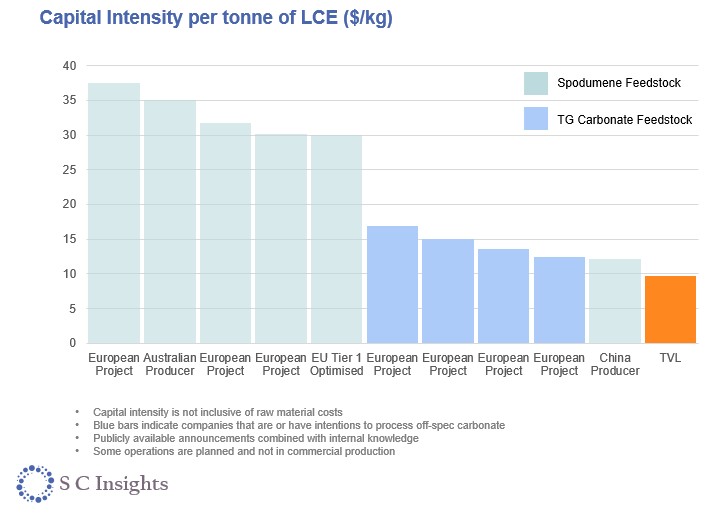
Tees Valley Lithium has announced the outcomes of its Front-End Engineering Design (FEED) programme for its proposed lithium hydroxide refinery in Teesside, confirming a technically defined, economically robust project positioned to progress towards Final Investment Decision.
The FEED outcomes confirm that Tees Valley Lithium is designed as a low-cost, merchant lithium refinery, capable of supplying battery-grade lithium chemicals to the rapidly growing European electric vehicle and battery market.
The FEED study confirms total capital expenditure of approximately US$243 million, placing Tees Valley Lithium among the lowest-capex lithium refining projects globally and, according to independent benchmarking by SC Insights, the lowest in Europe on a like-for-like basis.
Estimated operating costs are approximately US$33 million per annum, benefiting from Teesside’s established industrial cluster, integrated infrastructure, and the use of proven processing technology. Independent benchmarking positions the project at the low end of the global operating cost curve for lithium refining.
The combination of low capital intensity and low operating costs supports forecast EBITDA of approximately US$66 million per annum. Importantly, EBITDA is driven by processing margins rather than exposure to lithium price volatility. This results in more predictable, infrastructure-style cash generation.
The proposed facility is designed to produce 25,000 tonnes per annum of battery-grade lithium hydroxide monohydrate, a critical material for electric vehicle batteries. European battery manufacturing capacity is forecast to exceed 900 GWh per annum by 2030 (according to public announcements), equating to approximately 720,000 tonnes per annum of lithium carbonate equivalent demand (0.8kg LCE per KWh).
Against this backdrop, Tees Valley Lithium’s initial production capacity represents less than 3% of projected European demand, highlighting both the scale of the market opportunity and the potential for phased expansion.
The FEED outcomes define the project’s technical design, capital framework, site ownership, and execution strategy to a level that supports financing and progression towards Final Investment Decision. This represents a significant de-risking milestone in the development of the project.
Tees Valley Lithium has secured ownership of its Teesside industrial site, providing long-term control, cost certainty, and a stable platform for future expansion. The facility has been engineered using a modular, plug-and-play design philosophy to support efficient and controlled construction delivery.
The project is further underpinned by a binding offtake agreement covering up to 40% of initial production capacity with a wholly owned subsidiary of Glencore Plc, one of the world’s leading commodity companies. The offtake agreement provides early commercial validation and supports revenue visibility as the project advances towards financing and FID.
With the FEED programme complete to a level supporting financing and execution planning, Tees Valley Lithium is now progressing project financing, contractor engagement, and the remaining regulatory and permitting activities in parallel, with the objective of advancing the project to Final Investment Decision.
Tees Valley Lithium is being developed as a cornerstone piece of infrastructure for the UK and Europe’s battery supply chain, combining Teesside’s industrial heritage with a globally competitive cost structure and a clear focus on deliverability.

Lithium Hydroxide prices have surged nearly 80% over the past month, now trading at over $18,000/t, with some sources reporting Lithium Carbonate prices exceeding $20,000/t. This is a positive signal for the industry, as most experts place the incentive price, the threshold at which new lithium mining projects become financially viable, between $17,000–$20,000/t.
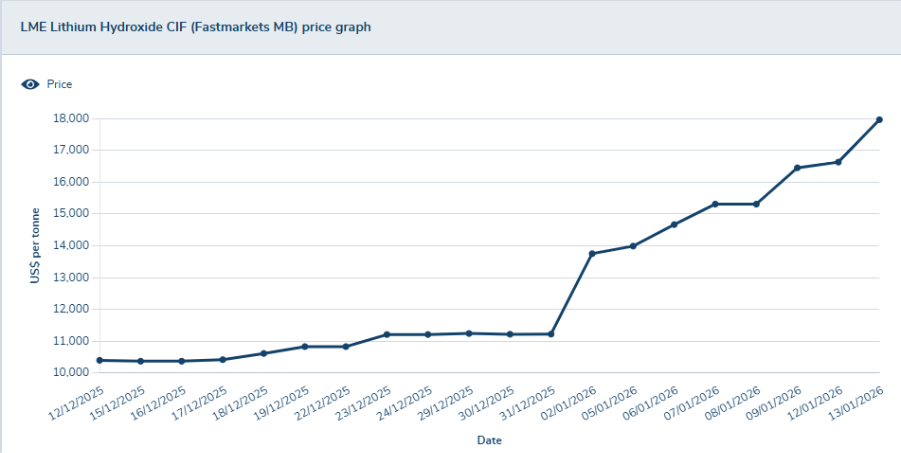
To meet the growing demand, more lithium extraction and refining capacity is urgently needed. Global demand is forecast to quadruple over the next ten years, while in the UK it is expected to increase tenfold. The industry broadly agrees that we have entered the next price cycle.
But what is driving this sudden increase? Global lithium prices remain heavily influenced by China, which controls over 70% of refining capacity worldwide. Last year, China tightened lithium mining regulations, particularly in Jiangxi province, revoking expired licenses and auditing mines operated by companies such as CATL. These actions triggered a price spike at the end of 2025 and resulted in depleted domestic inventories, as numerous mines were closed for months. Replenishing these inventories to preferred levels is expected to take over a year.
At the same time, demand from Battery Energy Storage Systems (BESS), while still smaller than demand from electric vehicles, exceeded expectations in 2025 and is projected to continue growing. Demand from EV batteries remains the primary driver of the market.
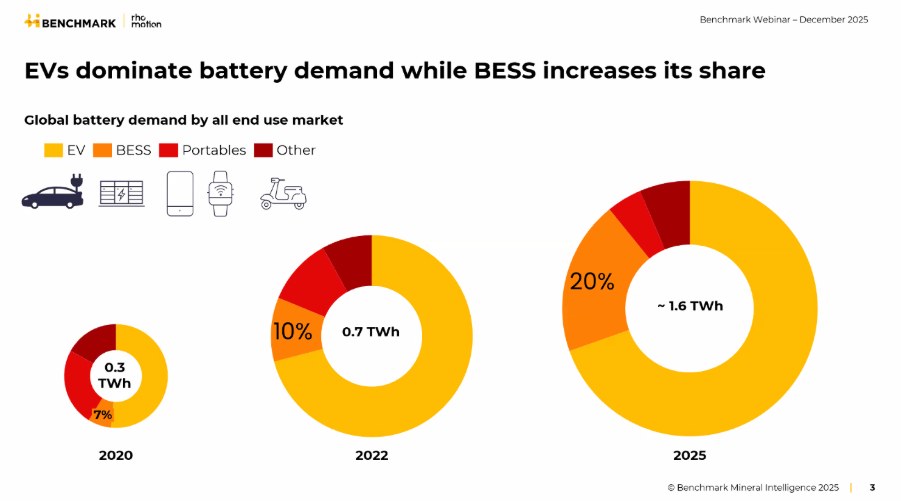
Neither of these factors is expected to reverse over the next 12 months. As a result, higher prices are expected to persist, with further increases likely in 2026 as concerns over a supply deficit continue to shape market sentiment.
At TVL, we kept advancing while others paused. That discipline means we’re now ahead of most new entrants and in a prime position to capture demand as it returns. Our project is fully aligned with Europe’s expected growth trajectory through 2028, putting us on the front foot as the market accelerates.
Gemma Cooper, Chief Commercial Officer
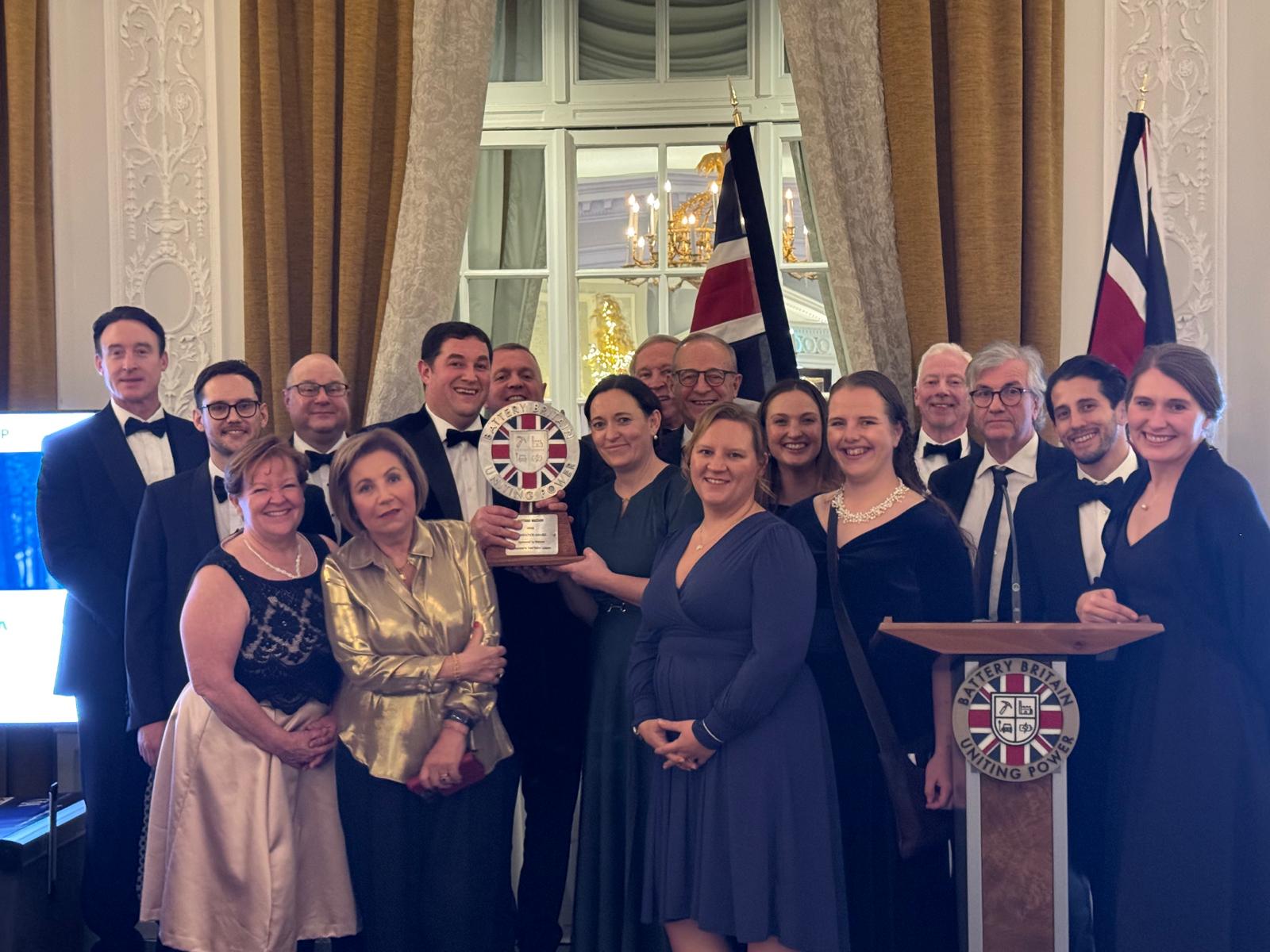
Tees Valley Lithium (TVL) is proud to announce that we have been awarded the Innovation Award at the 2025 Battery Britain Gala — a national celebration of the companies, technologies and partnerships shaping the future of the UK’s electrification and battery ecosystem. The honour recognises TVL’s pioneering work in establishing the UK’s first large-scale lithium refinery and delivering the midstream capability required to support gigafactories, strengthen supply chains and reduce reliance on long, carbon-heavy overseas processing routes.
The award was presented following a keynote speech delivered by Vikki Jeckell, CEO of Tees Valley Lithium, who addressed the realities of building industrial capability in the UK, the importance of partnership, and the strategic role Teesside will play in powering Britain’s energy transition. In her remarks, Vikki highlighted the eleven-hundred-percent increase in lithium demand projected under the UK’s new Critical Minerals Strategy, and emphasised that innovation is not just about patents or technology, it is also about building new industrial pathways, modernising supply chains, and delivering projects the UK has never had before.
She also spoke candidly about the challenges of building chemical processing facilities in the UK: the slowest planning approvals in the G7, higher construction costs than Europe, and operational pressures such as some of the highest industrial energy prices on the continent. But she noted that TVL is overcoming these hurdles through world-class engineering partnerships with Veolia and Wave International, a modular and UK-optimised design, and the strengths of Teesside’s globally recognised industrial heritage.
The room responded with enthusiasm, and the Innovation Award that followed reflected both the ambition of the project and the leadership TVL is demonstrating within the UK battery materials sector.
Below is the full transcript of the keynote speech delivered on the night.
Keynote Speech Transcript:
Good evening, everyone. It is a privilege to be here tonight, surrounded by people who are shaping the future of Britain’s energy, industry and innovation.
And before I go any further, I want to thank Richard and the organisers for bringing us together this evening. Events like this matter, because they give us the space to think, to connect, and to build momentum behind the projects that will define Battery Britain.
When we talk about batteries or gigafactories, it is easy to focus on the shiny end-products, the EVs rolling off production lines or the storage systems powering the grid. But the truth is this: nothing happens without the materials. They are the heartbeat of the energy transition. And for too long, we have relied on long, fragile, carbon-heavy supply chains.
We therefore welcomed the recent release of the UK’s new Critical Minerals Strategy. A strategy that openly acknowledges that the UK’s demand for lithium is set to rise by eleven hundred percent by 2035. For many, it was simply a policy announcement. But for those of us building projects on the ground, it felt like something much bigger. It felt like a signal that Britain is ready to step back into a role it knows well a nation that builds things, that leads in engineering, and that backs its own ambition.
And for us this strategy also felt like recognition of what regions like Teesside have always known: that places with deep industrial heritage, world-class engineering talent, and communities built on making things possible, are exactly where Britain should be investing. Teesside powered the industrial revolution once and today it is ready to power the battery revolution.
But ambition on its own is not enough.
If the UK truly wants to rebuild industrial capability, we must also recognise the scale of the challenge in front of us. Because building a new facility here, particularly a chemical processing plant, is not easy. In fact, it is one of the hardest industrial undertakings in this country.
So, before I talk about what we are doing at TVL, let me start with the reality of the environment we are operating in. The statistics tell their own story.
The UK has the slowest industrial planning approvals in theG7, with major projects often taking five to seven years before a spade even touches the ground. Nearly sixty percent of large UK projects run late or overbudget, and we build new industrial facilities at less than half the speed of many of our competitors. And it costs more too, building a new plant in the UK can be twenty to thirty percent more expensive than constructing the same facility elsewhere in Europe.
And that is just the construction side.
Operating a chemical plant here comes with its own pressures. Large energy users in the UK pay between twenty and eighty percent more for electricity than their counterparts in France, Germany or the Netherlands. Carbon and compliance costs are among the highest in Europe. Andover the past two decades, this environment has contributed to almost half of the UK’s large chemical production sites closing.
These are not small hurdles.
They are structural disadvantages, the kind that would make most companies choose not to build here at all.
And yet, despite all of those challenges, Tees Valley Lithium is proving that it can be done and can be done well.
We have built this project in a way that turns those disadvantages into strengths. By partnering with Veolia and Wave International, we are using proven, world-class technology and disciplined engineering to shorten timelines, reduce risk and remove uncertainty from construction. We chose Teesside because it gives us access to an existing chemical cluster, a skilled workforce, shared infrastructure, and a region that knows how to build complex plants safely and efficiently. And we have designed a refinery that is modular, expandable and optimised for UK conditions, allowing us to manage energy use, streamline operations and control costs far more effectively than traditional, older plants.
In short, we are overcoming the barriers by doing three things well, choosing the right partners, choosing the right region, and choosing a design that fits the UK of today, not the UK of twenty years ago. And that is how TVL is turning one of the hardest industrial environments in the world into one of the most strategic opportunities for Britain.
At Tees Valley Lithium, that is the mission we are driving forward.
Tonight, we are joined by two of our most important partners: Veolia and Wave International. They represent something powerful: not just technology and engineering, but the idea that when the right partners come together with a shared purpose, the impossible becomes achievable.
Now, in terms of our progress.
Our FEED study is in its final stretch. Months of engineering, design and operational planning have brought us to a point where our focus now shifts from designing to constructing. Every part of the project is moving, in parallel, with purpose, and with pace.
And when we reach first production in early 2028, we will be doing far more than producing battery-grade lithium. We will be creating skilled jobs, anchoring supply chains, strengthening gigafactories, and positioning Britain as a credible, competitive player in global battery materials.
Which is why tonight feels hopeful.
Because when government, industry, investors, engineers and innovators come together, when partners like Veolia and Wave stand alongside a region like Teesside, we unlock the kind of industrial capability that Britain needs to compete and win.
So my message is simple.
Britain can do this.
Teesside can do this.
And together, we are already doing it.
Thank you and I look forward to speaking with many of you this evening about how we can all be part of the next chapter of Battery Britain.
Vikki Jeckell
CEO Tees Valley Lithium


Tees Valley Lithium Ltd. is a registered company in the United Kingdom. The company is committed to operating in accordance with applicable environmental, regulatory, and industry standards. All partnerships and activities are conducted with a focus on transparency, sustainability, and ethical business practices.

.svg)
.png)